Schrödinger's Cat: The Feline Behind the Quantum Curtain
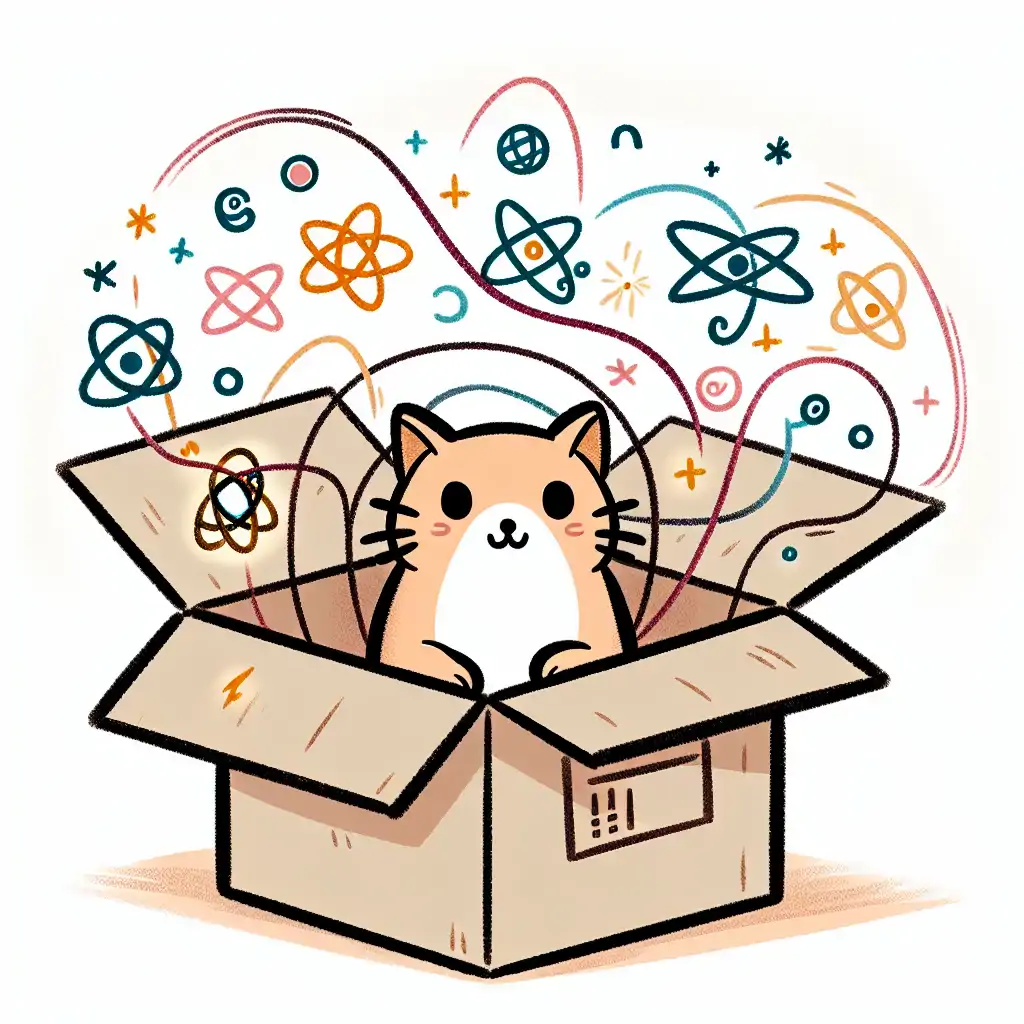
Ever wondered why a cat would become the funniest symbol in the world of quantum physics? Well, pull up a chair and grab your curiosity hat because we’re about to embark on a journey through the whimsical world of Schrödinger's Cat! The concept might seem daunting at first—after all, isn’t quantum physics supposed to be the stuff of brainy scientists and not your average cat lover? Fear not! We’re here to unravel the mystery with a sprinkle of humor and a dash of simplicity. Schrödinger's Cat is more than just a curious feline in a box; it’s a thought experiment that brings light to the peculiarities of quantum superposition, where a cat can be both alive and dead at the same time—until you dare to peek inside the box. Intrigued? You should be! As we explore this thought experiment, your understanding of quantum phenomena might just unravel into something pawsitively enlightening.
The quantum curtain opens, and we find our famed feline nestled in a theoretical experiment like no other. Erwin Schrödinger, the man behind the cat, wasn’t actually a fan of animal cruelty (no feline was harmed in the making of this theory), but he did find himself tangled in a realm of quantum quirks that he struggled to interpret. Imagine a realm where outcomes coexist, where possibilities are countless, and where certainty takes a nap. Welcome to the world of quantum superposition—a world that’s as intoxicatingly complex as it is mind-bendingly simple. And what better way to illustrate this conundrum than with a paradoxical cat in a box? Through this thought experiment, Schrödinger spurred discussions that have continued to echo through the corridors of physics.
Let’s hop back to 1935, a time when flappers danced, jazz was hot, and Erwin Schrödinger was cooking up a storm in the world of quantum mechanics. Enter our heroic cat, symbolizing a concept as perplexing as quantum superposition—a state where particles can exist in multiple states at once. Imagine your cat choosing between tuna and chicken and somehow enjoying both simultaneously. Schrödinger's intention was to showcase the weirdness of quantum theory, using our feline friend as a mugshot for a bigger quantum dilemma—one that even Einstein would ponder with a puzzled expression.
Now, let’s dive deeper into the box. Picture this: a cat, a vial of poison, a Geiger counter, some radioactive material, and a hammer, all neatly confined in a small space. Sounds like the setup to a peculiar mystery novel, doesn't it? But wait! Here’s where it gets fascinating. The fate of the cat hinges on the decay of a radioactive atom—a quantum event with uncertain timing. This means that until someone opens the box and observes, the cat exists in a precarious dance of life and death. Is it a zombie kitty or a regular tabby? According to quantum mechanics, it’s both!
Now, before you pull out your rescue cape ready to uncover the cat, remember this is a thought experiment—every essence about the cat is theoretical. Schrödinger crafted this scenario to spark intrigue, poking at the contradictions within the Copenhagen interpretation of quantum mechanics. The Copenhagen interpretation suggests that quantum particles remain in superposition until observed, and it's this very observation that determines their state. Hence, until you crack that box open, the cat cheekily flaunts its undead charms across space-time.
Superposition is not just a word fit for a superhero comic; it’s the jam that sandwiches quantum physics together. It’s what allows particles like electrons to wear multiple hats at the same time. Need an electron here? Sure! Want it there? No problem! It might even be having a disco in a parallel universe while sipping on quantum mojitos. This baffling concept is beautifully encapsulated in Schrödinger’s rebellious whiskered protagonist—a notion as amusing as trying to solve a Rubik’s cube with your eyes closed.
This thought experiment might seem like something cooked up in a mad scientist’s imagination station, but it carries profound implications. The heart of it lies in the paradox—our inability to comprehend this coexistence of states defies the very notions of reality that we cling to in our day-to-day life. How does it transform our understanding beyond the cat and the box? It invites us to consider the multiverse, quantum computing, and the essence of consciousness. Schrödinger's cat is less about a furry companion and more about the portal it opens into the vast, peculiar landscape of quantum possibilities.
Quantum physicists are like explorers navigating uncharted territories without a map—or perhaps with a map that changes every time they look at it. Schrödinger’s Cat poses the brain-boggling question: Is reality determined by observation, or does it hold another mysterious fabric altogether? This is where quantum entanglement walks on stage, linking particles across distances as if they are having a universal group chat that transcends our traditional understanding of communication. Schrödinger might not have liked his cat analogy, but it made a chin-scratching riddle entertaining even for the quantum skeptics!
Let’s not shy away from the advances and quirky counterparts in quantum physics that followed. Quantum physicists didn’t drop their pencils and go home; they leaped into the quantum wonderland headfirst. The cat-in-the-box scenario inspired countless other debates, theories, and interpretations in the following years. It forced scientists to rethink 'Now you see it; now you don't' as more than just a magician's trick. Quantum mechanics tells us the world is not as it seems, and what’s more mischievous than a Cheshire Cat grinning at the boundaries of reality itself?
Somewhere beyond Schrödinger’s playful paradox, quantum superposition dances across real-world applications—enter the looming and lucrative arc of quantum computing. Quantum computers, like Schrödinger’s cat, harness the power of superposition, allowing them to be in many states at once, thus processing information at an astounding pace. Essentially, if Schrödinger’s cat were a quantum computer, it would not only be alive and dead but also solving mathematical equations while planning a heist in an alternate dimension!
But why should you, dear reader, care about odds-defying feline antics? Apart from the sheer entertainment, Schrödinger’s Cat serves as a palatable glimpse into the baffling yet beautiful maze that is quantum physics. It’s a conversation starter at dinner parties and a way to ponder how reality is stitched together at the seams. Whether you’re a science enthusiast or someone who simply prefers the tactile certainty of smooth peanut butter, this discussion has something for everyone. The cat-scenario is a unifying amusement that sidesteps the polarizing nature of physics and invites anyone with a sense of curiosity to join in the quantum ballet.
Quantum mechanics isn't without its complexities, but through the lens of Schrödinger's benignly boxed cat, those complexities become a shade more approachable. Might we suggest imagining each atom as a cat with a choice? You're either observing them in the litter box cleanup or catching them in the act of stealing your warm seat on the couch. Schrödinger dared to make quantum phenomena accessible, and we honor that age-old quest by attempting new interpretations with the same feline-centered flair.
Let us untangle another thread. The world of quantum mechanics isn’t an all-or-nothing gambit. Rather, it enriches our understanding by challenging the linear, straightforward pigeonholes we’ve created. Like Schrödinger's charming enigma of a cat, the atom’s antics remind us that processes can nuzzle into layers of potential beyond what we can predict. Quantum physics isn’t daunting; it’s genuinely part of our reality, as wonderfully confounding as it is exciting.
By now, your head might be swimming with inconclusive feline fantasies and quantum quandaries. But take a pause, for that's exactly where Schrödinger wanted us—to dwell in the 'what-ifs', to challenge our perceptions, and to stretch our cognitive abilities. So, the next time you see your cat napping in a sunbeam while pondering deep philosophical matters, you might speculate on its secret ambidextrous dance through alternate quantum dimensions. How could you possibly look at a curled-up kitty the same way again?
Schrödinger's lovely act is about more than simply tossing a cat-and-poison illustration into the scientific ether. It challenges the very heart of observation, reality, and what's lurking behind those perceptions. Until we peek behind myriad cosmic curtains and examine the box, we may never know with certainty. Until then, Schrödinger's feline companion continues to beguile those willing to roam the landscapes of science or mischievous imagination.
The beauty of Schrödinger’s hypothesis lies in its simplicity and duality—a timeless thought that not only tossed a cat into a box but flung open new realms of interpretation, innovation, and invention. Supercomputers, multiverse theories, quantum encryptions—all, in a sense, owe a nod to a curious cat chilling in quantum ambiguity. Isn’t the wonder of science, after all, rooted in exploration where toys are tossed in cat-friendly paradoxes?
Now that we've followed our feline friend down this quantum rabbit hole, we must salute the revolution it created within the scientific realm. Tooth and claw notwithstanding, Schrödinger’s allegory stands as a beacon of inquiry and a charming invitation to dance with nature's most perplexing puzzles. And remember, folks, no cats (or scientists) were harmed in the unfolding of this cosmic conundrum.
As we close the lid on Schrödinger's whimsical cat box, take a moment to reflect on this peculiar feline who coaxed the world into rethinking the fabric of reality. Schrödinger’s Cat may be a thought experiment with paws and paradoxes, but it remains a cornerstone of quantum storytelling. Imagining a cat existing in dual states of being transforms a brain-twisting concept into an accessible and endearing tale. Whether we grasp every emerging implication or embrace the mystery, Schrödinger’s metaphor offers a springboard—a leap into a universe brimming with invisible intricacies and possibilities.
In the grand tapestry of science, each thread contributes to unveiling the unknown. Schrödinger’s playful narrative gave physics a touch of whimsy and audacity and had us pondering the philosophical intertwined with quantum mechanics. It blends skepticism and imagination into audible whispers that urge us to unstop and ponder the deeper aspect of our very existence. Until the day we unlock every mystery hidden in the cosmos, we have the Schrödinger's Cat paradox as a reminder to be curious, to speculate, and above all, to enjoy this magnificent dance of atoms and possibility.
So, let’s keep our whiskers twitching with curiosity and our minds wide open to explore the quantum frontier. Schrödinger’s Cat, in its quantum ambiguity and mischief, invites us to envision a world where imagination meets reality on an unparalleled stage. Here's to the cat behind the curtain—a companion in our journey across the spectacular realm of physics.

Katie
Katie is a wildlife guru by day and a passionate part-time blog writer. With her deep expertise in nature and a gift for vivid storytelling, she crafts compelling articles that bring the wonders of the wild to life, captivating readers with her knowledge and love for the natural world.
A proud member of the B-Team
If you're curious to dive deeper into related topics, then you may find these external links useful.
1. Schrödinger's Cat Explained
This link provides a comprehensive explanation of Schrödinger's Cat, dissecting its role in quantum mechanics and its impact on scientific dialogue.
https://sciencing.com/schrodingers-cat-simplified-what-is-it-why-is-important-13722577.html2. Quantum Superposition: The Heart of Schrödinger's Experiment
Explore the concept of quantum superposition in detail, essential to understanding the Schrödinger's Cat thought experiment and its implications.
https://en.wikipedia.org/wiki/Quantum_superposition3. The Copenhagen Interpretation of Quantum Mechanics
This link delves into the Copenhagen interpretation, explaining its significance and how it relates to Schrödinger's Cat and the role of observation in quantum states.
https://en.wikipedia.org/wiki/Copenhagen_interpretation4. Quantum Mechanics and Everyday Reality
Learn how quantum mechanics, illustrated by Schrödinger’s Cat, influences real-world applications like quantum computing and multiverse theories.
https://www.scientificamerican.com/article/bringing-schrodingers-quantum-cat-to-life/5. Historical Insights: Erwin Schrödinger
A historical perspective on Erwin Schrödinger’s life and works, with a focus on how his cat thought experiment revolutionized views in physics.
https://www.britannica.com/biography/Erwin-Schrodinger©2023 - 2026 SP Software Solutions Ltd. All rights reserved.