Quantum Gravity: The Down-to-Earth Guide to Galactic Levitation
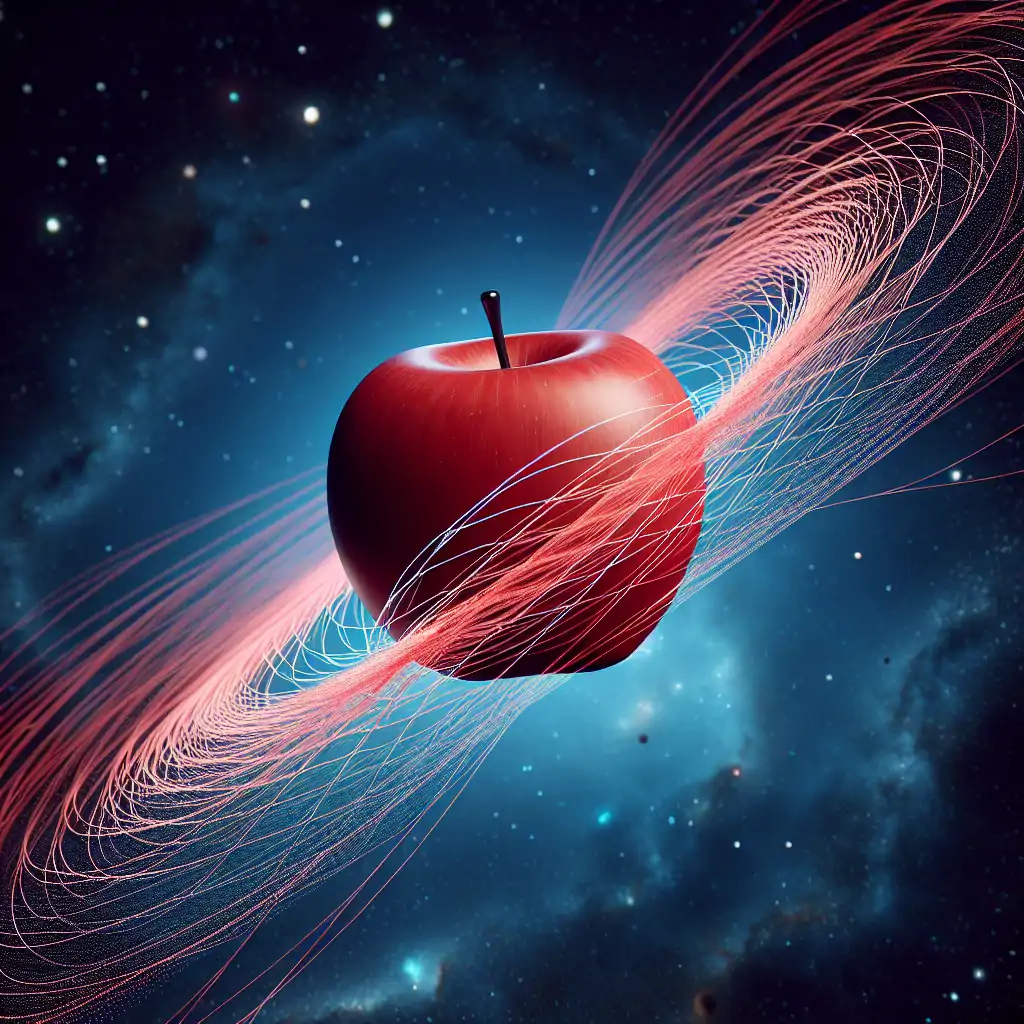
Have you ever contemplated whether gravity is just the universe's gentle hug or a stern schoolteacher telling particles where to go? It's a profound quandary that has left many a physicist scratching their head and many an apple looking suspiciously at its tree. Strap in, because we're about to embark on a journey through a realm where gravity takes on a personality all its own—a quantum twist, if you will. In this blog, we're not just tackling any old topic; we're diving headfirst into the peculiar playground of quantum gravity, a place where small things like quarks, spaces, and possibly sanity, are in short supply but in high demand.
Imagine a world where space isn't a mere void but a spaghetti-like tangle of quantum strings and particles. Newton might have dropped his apple, but in the land of quantum gravity, that apple might just levitate or do a jazzy little dance on its way down. We're talking about a grand cosmic circus where gravity gets funky, and the universe might be a tad less predictable than your grandmother's Christmas pudding. Forget about equations that make your brain hurt. Here, we're serving a buffet of bite-sized, quark-flavored concepts that will have you laughing and scratching your head in equal measure.
So, what is quantum gravity, exactly? Think of it as the universe's ultimate plot twist! It challenges us to imagine a cosmos hung delicately on a cosmic trampoline, where spacetime isn’t as solid as we once believed. It’s a tale where Newton meets Schrödinger and they both ask Einstein if he can believe his eyes. Ready to dive into the delightful chaos where gravity could go rogue and where reality might just be a holographic projection? Buckle up; it's time for a whirlwind trip through this wacky world where the only certainty is uncertainty, perfectly at home in a universe that relishes a good laugh.

Picture this: gravity as we've known it, the force keeping our feet snug on the ground and our planets in comfy orbits, might just be a little more cosmic than Newton imagined. Welcome to the complex world of quantum gravity! Unlike classical gravity, which acts on large, everyday objects resulting in predictably falling apples, quantum gravity concerns itself with the universe’s tiniest scales. Here, spacetime is not the smooth curve of Einstein's theory but a quantum froth, bubbling with potential and uncertainty, sporting a very fancy, albeit unpredictable, wig.
This frothy landscape paints a picture where spacetime, rather than being a continuous fabric, is more like ragged lace, woven from the finest quantum threads you could (not) see. Think of it like a cosmic trampoline, where the heaviest objects cause the deepest dips, but at a quantum level, even the trampoline itself has a sense of humor about how it bends and bounces. In this arena of cosmic slapstick, gravity is both the punchline and the setup to its own joke, creating a dance that only reality seems to hear.
The concept of spacetime itself morphs into something nearly mystical. It challenges physicists to think in dimensions where dimensions aren't so straightforward. Imagine if you woke up and suddenly the three dimensions you're used to—length, width, and height—started behaving like cheeky suggestions rather than rules. In a universe governed by quantum gravity, the very nature of these dimensions becomes fluid, potentially curling up into tiny loops that defy our everyday ideas. It’s as if the universe is whispering, 'Surprise!' at every corner.
This mysterious dance begs the question: what exactly governs this seemingly lawless land? Quantum gravity aims to meld the orderly nature of general relativity with the chaotic unpredictability of quantum mechanics. It's the Einstein and Schrödinger waltz, a tango between particles and waves, where even time might trip over its untied shoelaces into a temporal tangle. It’s the wildest mashup since chocolate met peanut butter, and it's sure to leave everyone's mind pleasantly boggled.
One of the profound challenges physicists face in this dance is understanding how gravity—a force we perceive on a massive scale—interacts at the quantum level. Where classical physics describes forces like gravity, quantum mechanics delves into probabilities and fields at the smallest scales. The quest to find a unified theory that describes both realms is akin to finding a needle in a haystack while the haystack occasionally vanishes due to quantum fluctuations. A goose chase of cosmic proportions, if you will!
The search for a unified theory has led to many theories, but none as intriguing as the notion of 'loop quantum gravity.' Here, spacetime is imagined as a vast tangle of loops, interwoven into a dense and dynamic web at the Planck scale. It proposes that the geometry of space is quantized, much like everything else in quantum mechanics. The universe dances atop a fine mesh of loops, suggesting that continuous spacetime is perhaps more like a shimmering strobe light of existence, popping in and out, yes, no, and maybe.
But why does this matter? Reflect on gravity's role in shaping the cosmos, influencing everything from galaxies to amoebas. Understanding quantum gravity could shed light on colossal cosmic events like the Big Bang or black holes—events where both general relativity and quantum mechanics should theoretically interact. It's like needing both a detective and a magician to solve a mystery that might not even exist, yet influences the very stuff of reality.
Quantum gravity might also provide clues to the legendary Theory of Everything, the philosophical holy grail of physics. Bridging the gap between the macroscopic and quantum worlds could reveal insights into the very essence of the universe, explaining why it takes the peculiar form it does. It's an ambitious endeavor—like trying to sketch all of history on the back of a postage stamp—that continues to drive researchers and excite dreams of cosmic understanding.
Our journey doesn't merely stop at loops. String theory, another contender in this cosmic soap opera, also tries its hand at explaining gravity's quantum quirks. It imagines all particles as tiny vibrating strings, with gravity emerging as one of many vibrational patterns. These strings vibrate through a multiverse of dimensions, some compact and curled up, others expansive like our own. In this grand ensemble, physics plays a symphony that's at once familiar and inexplicably exotic.
String theory suggests a universe where gravity is just one strand in a grand cosmic tapestry, interwoven with other fundamental forces. It's an elegant unification where everything, from the quarks in your breakfast cereal to the stars in distant galaxies, might just be musical notes on a universal score. And just like any good piece of music, it’s both predictable and wildly unpredictable, reflecting the curious, sometimes contradictory nature of quantum mechanics.
As researchers continue seeking harmony between quantum mechanics and the classical realm of gravity, they confront not just scientific challenges but philosophical ones. What does it mean to have a universe where reality shifts depending on scale? Where do we find solace when truths become relative and existence wobbles between states? In some ways, seeking a theory of quantum gravity is as much about confronting the fundamental nature of our understanding as it is about understanding nature itself.
For the curious storyteller and philosophical adventurer, quantum gravity opens doors to rethinking how we perceive reality. Could our linear understanding of time and space be mere constructs, a handy framework draped atop a universe that laughs with quantum whimsy? Might stories of parallel universes not just be science fiction flights but reflections of an existential reality too grand for everyday comprehension? It poses the question in the grandest possible terms: what if science were myth and myth science?
The labor of love required to unravel such profound mysteries is borne by physicists who, often with furious scribbling and heads tilted at extraordinary angles, prose into equations that many would find more bewildering than beautiful. Yet, therein lies the charm—a sort of intellectual romantic comedy with the cosmos, where understanding remains elusive yet tantalizingly close, flirting on the brink of human comprehension.
Aside from theory, experimental efforts are also underway to catch the elusive dance of quantum gravity. From the precision of gravitational wave detectors to the potential insights offered by particle colliders, each advancement we make in observing the universe offers another puzzle piece. The journey might be long, and like any good tale, it is replete with setbacks, surprises, and those precious 'Eureka!' moments where the universe authentically winks in return.

And there we have it, dear travelers through spacetime and theory—a whimsical wander through the world where gravity might just be pulling a fast one on us all. From the spaghetti tangle of quantum threads to the grand operatic interplay of string theory, quantum gravity challenges not only our understanding but our imaginations. It dares us to rethink everything we think we know about the universe's fabric, highlighting that at its heart, the universe might be as playful as it is profound.
Quantum gravity reminds us that in the cosmic theater, the script might not be final after all. There are roles yet unwritten and endings unplanned, inviting physicists to keep exploring the depths of their curiosity. Whether the answers lie in looped geometries or vibrational symphonies, what matters most is the journey, the unyielding quest for knowledge that propels humanity forward.
So, let's keep pondering, laughing, and exploring. Who knows, maybe one day we'll solve the mystery of quantum gravity and hang our understanding of spacetime like a new universe around Newton's apple. Until then, embrace the whimsy, the wonder, and the possibility that in quantum gravity, the universe may just be tipping its hat and nodding, 'Indeed, 'tis a peculiar show.'
Thanks for taking the time to read my article! You may also find this one interesting.
Quantum Fluctuations: The Cosmic Nudge of DestinyTil next time! Katie

Katie
Katie is a wildlife guru by day and a passionate part-time blog writer. With her deep expertise in nature and a gift for vivid storytelling, she crafts compelling articles that bring the wonders of the wild to life, captivating readers with her knowledge and love for the natural world.
A proud member of the B-Team
If you're curious to dive deeper into related topics, then you may find these external links useful.
1. Quantum Gravity for Beginners
An introduction to the basics of quantum gravity, explaining its concepts and significance in physics.
https://arxiv.org/abs/1108.32692. Loop Quantum Gravity Explained
A detailed insight into loop quantum gravity, describing its approach to understanding spacetime and fundamental forces.
https://en.wikipedia.org/wiki/Loop_quantum_gravity3. String Theory: The Musical Universe
A comprehensive look at string theory, highlighting how it attempts to unify gravity with other fundamental forces.
https://medium.com/@william4trad/unraveling-the-cosmic-symphony-a-comprehensive-review-of-the-string-theory-7108869c58024. The Search for a Theory of Everything
An exploration of the quest to develop a unified theory, connecting classical and quantum physics together.
https://link.springer.com/article/10.1007/s10773-024-05574-25. Experimental Approaches to Quantum Gravity
An overview of current experimental methods in exploring quantum gravity, including gravitational wave detection and particle colliders.
https://link.springer.com/book/10.1007/978-3-319-64537-7©2023 - 2026 SP Software Solutions Ltd. All rights reserved.